

How to Learn Low-Level Design from ZERO in 2026

In this article, I’ll give you a complete step-by-step roadmap to learn Low-Level Design or LLD from scratch covering exactly what to learn, the right order to learn it, and how to prepare effectively for low level design interviews.
I have also linked resources where you can learn LLD topics in detail.
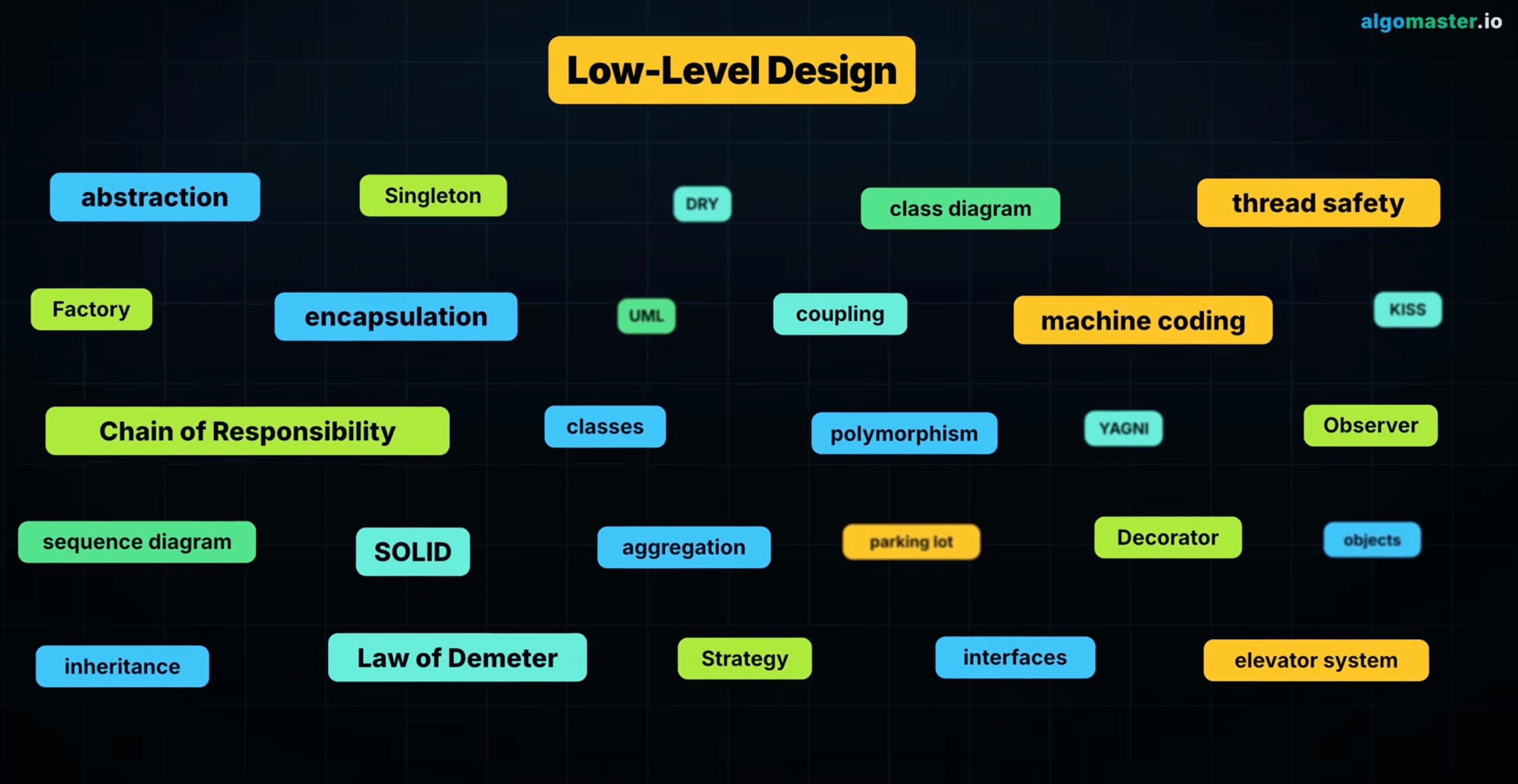
Today, many companies include LLD rounds in their interview process, sometimes even for entry-level roles. That is why having a strong foundation in LLD has become increasingly important.
LLD is also useful beyond interviews. It helps you design software that is easier to understand, maintain, and extend.
I also created a 10-minute YouTube video on how to learn LLD packed with visuals and animations.
Subscribe for more such videos!
What exactly is Low-Level Design?
First, lets clarify what low-level design actually means and how it differs from high-level design or system design.
Low-level design, or LLD, is a form of software design that focuses on implementation details.
High-level system design focuses on the bigger picture. It answers questions such as: How should the system scale? Which databases should we use? How should different services communicate? and How should we handle traffic, caching, message queues, and failures?
Low-level design goes one level deeper. It focuses on questions such as: What classes should we create? What should each class be responsible for? How should different objects interact? Which interfaces, methods, and data models should we define? How do we keep the code readable, extensible, and maintainable?
Types of Low Level Design Interviews
Low-level design interviews can appear in different formats depending on the company, the role, and the level you are applying for.
The three most common formats are object-oriented design, machine coding, and concurrency design.
Object-Oriented Design
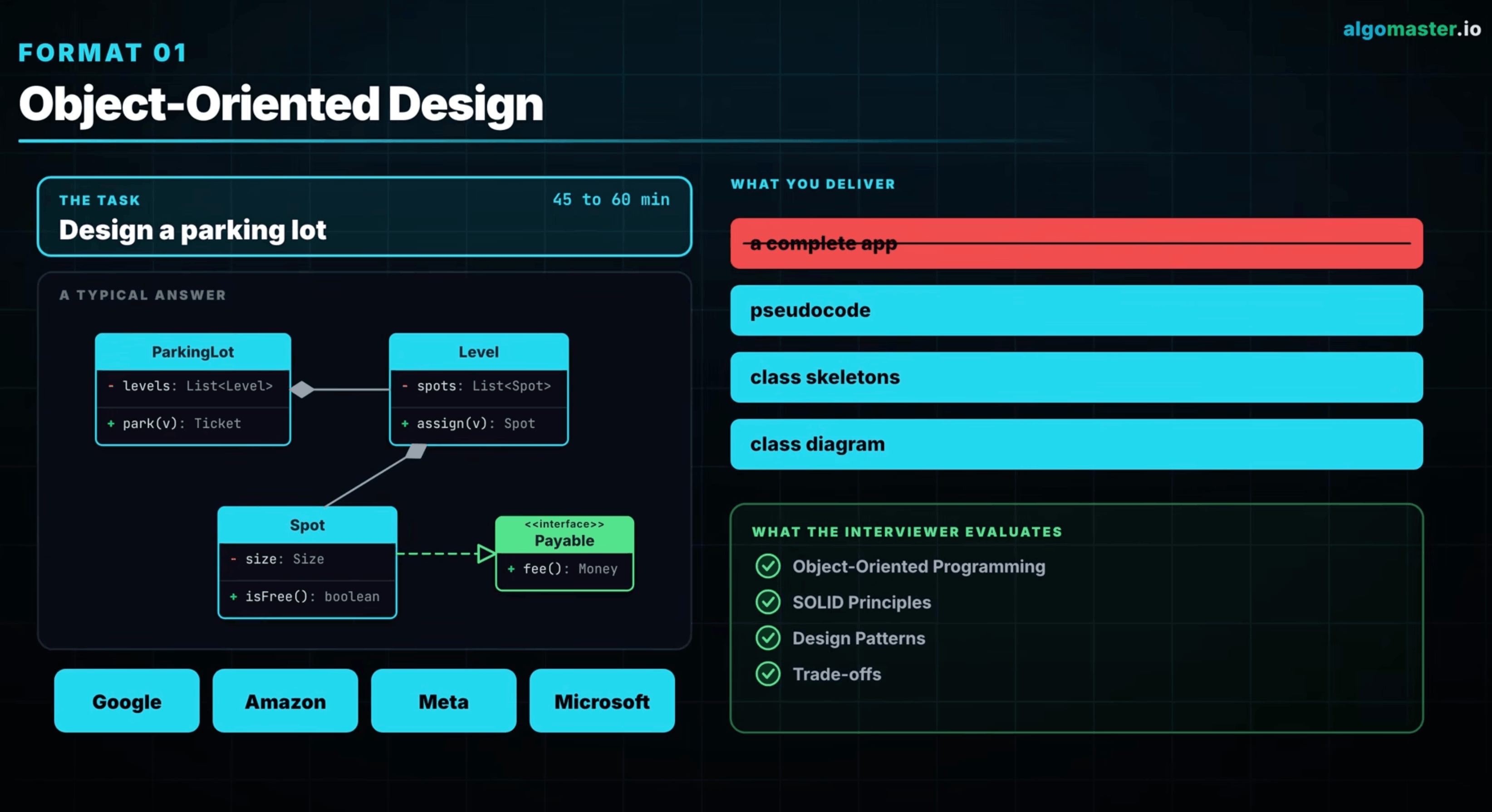
Object-oriented design is the most common type of LLD interview at major technology companies such as Google, Amazon, Meta, and Microsoft.
You may be asked to design a system such as a parking lot, elevator system, or a library management system and expected to identify the main classes, interfaces, methods, attributes, and relationships between different objects.
These interviews typically last between 45 and 60 minutes. You are usually not expected to build a complete application. Instead, you may write pseudocode, create class skeletons, or draw a class diagram.
The interviewer evaluates your understanding of object-oriented programming, SOLID principles, design patterns, trade-offs, and how clearly you explain your decisions.
Machine Coding
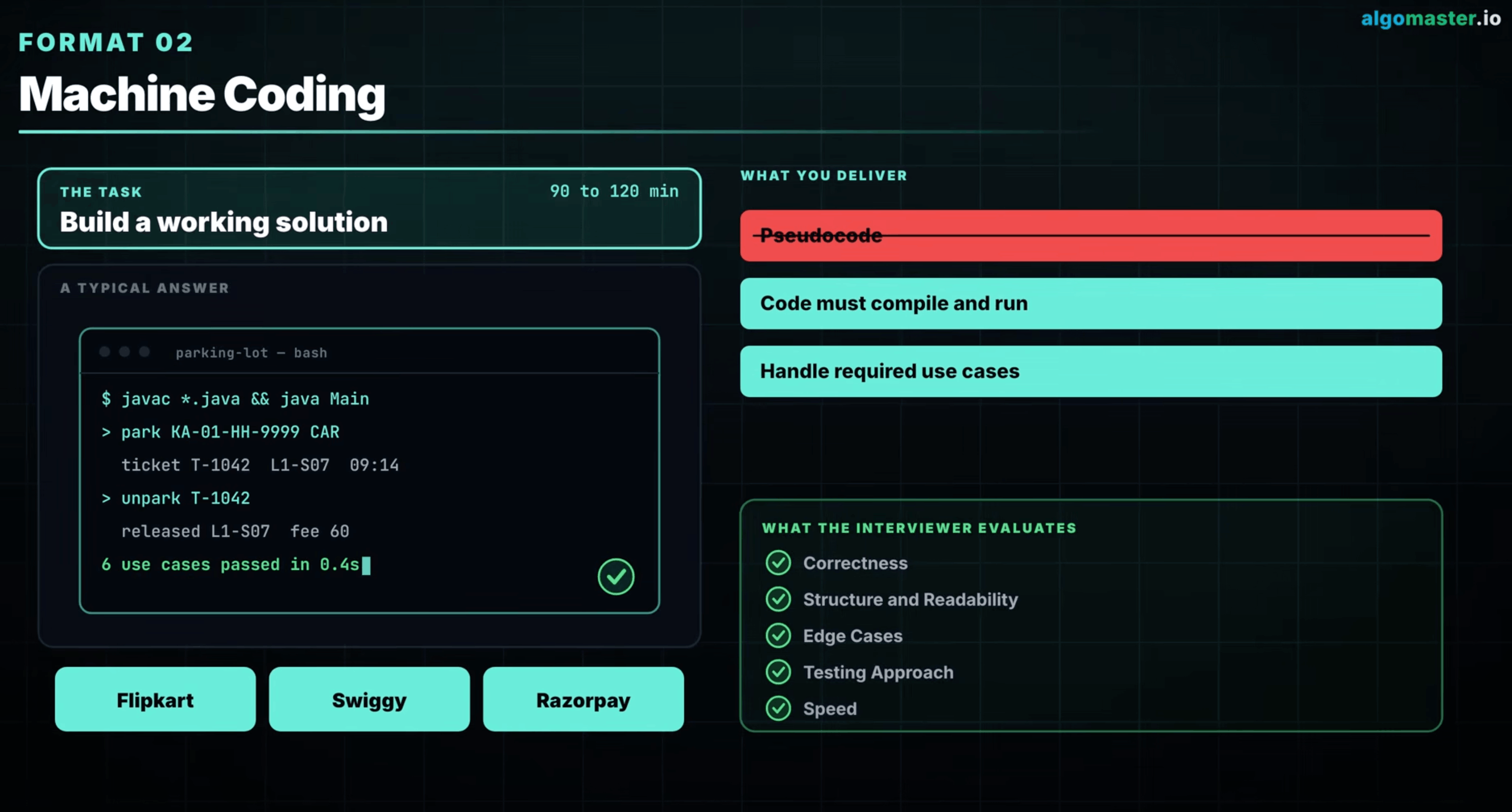
In a machine coding interview, you are expected to build a complete, working solution within a limited amount of time.
This format is especially common at Indian tech companies and startups, and the round usually lasts between 90 and 120 minutes.
Unlike an object-oriented design interview, pseudocode is not enough. Your code must compile, run, and correctly handle the required use cases.
The interviewer evaluates the correctness of your solution, the structure and readability of your code, how well you handle edge cases, your testing approach, and how quickly you can turn a design into working software.
Concurrency Design
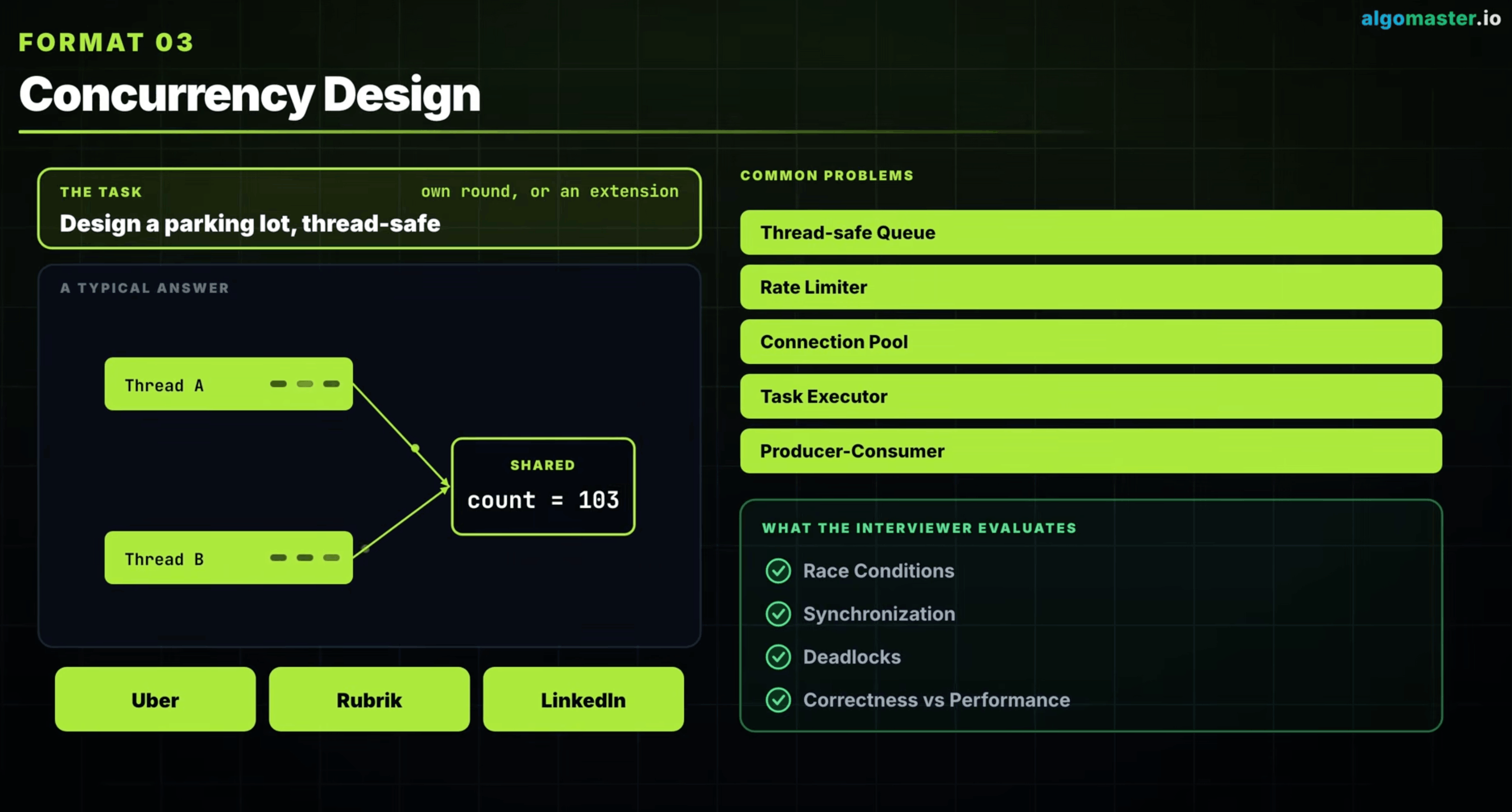
Concurrency interviews focus on systems that must behave correctly when multiple threads access shared data at the same time.
Concurrency may be the main problem, or it may appear as an extension to a regular LLD question. For example, after designing a parking lot, the interviewer might ask how you would make it thread-safe.
You may also be asked to design a thread-safe queue, rate limiter, connection pool, task executor, or producer-consumer system.
The interviewer evaluates whether you can identify race conditions, choose appropriate synchronization mechanisms, prevent deadlocks, and balance correctness with performance.
A good starting point in these interviews is to identify the shared state and understand how different threads might read or modify it concurrently.
Pick One OOP Language
Since LLD involves writing actual code using classes, objects, interfaces, and reusable components, you need to be comfortable with at least one object-oriented programming language.
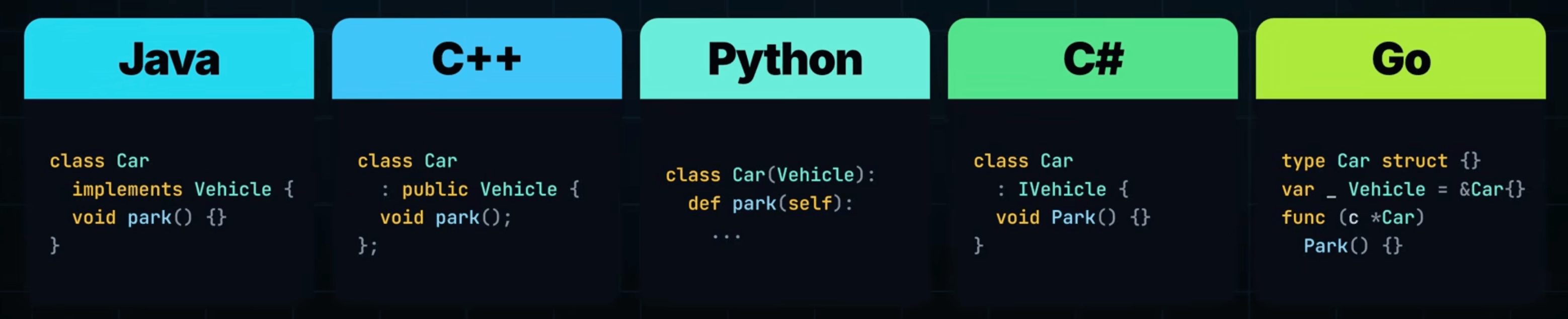
I personally use Java because most of my professional experience has been around it. Java is also a popular choice for LLD interviews because it provides strong support for object-oriented programming and is widely used in backend development.
But you can also use C++, Python, C#, or even Go depending on what the company allows and which language you are most comfortable with. Then use that same language consistently while practicing low-level design problems.
The language itself matters far less than your ability to express a clean and maintainable design using it.
Basic OOP Concepts
Once you have chosen a programming language, the next step is to learn the fundamentals of object-oriented programming.
At its core, low-level design is about taking a real-world problem and representing it through classes, objects, interfaces, and relationships.
Start with the basic building blocks of OOP, including classes, objects, constructors, enums, interfaces, abstract classes, and access modifiers.
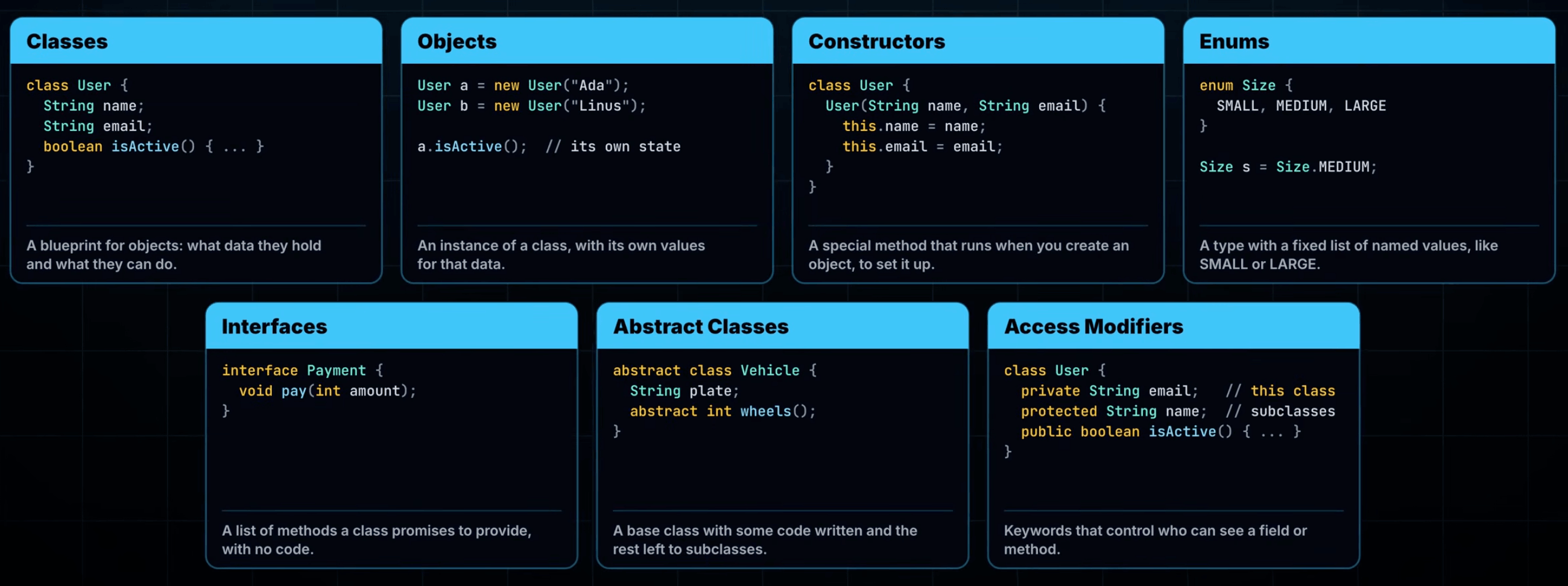
You can learn these OOP fundamentals here.
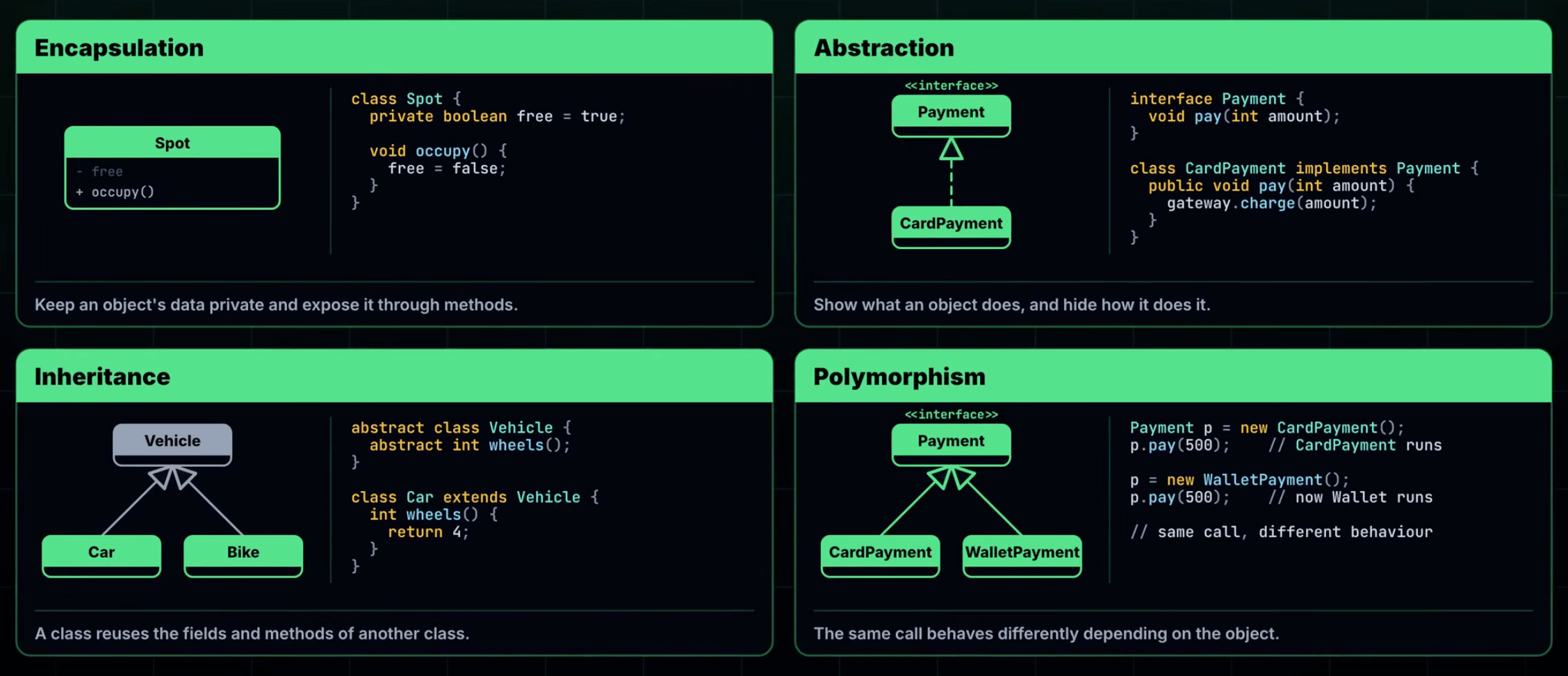
Then learn the four core principles: encapsulation, abstraction, inheritance, and polymorphism. These principles help you design classes that are easier to understand, extend, and maintain.
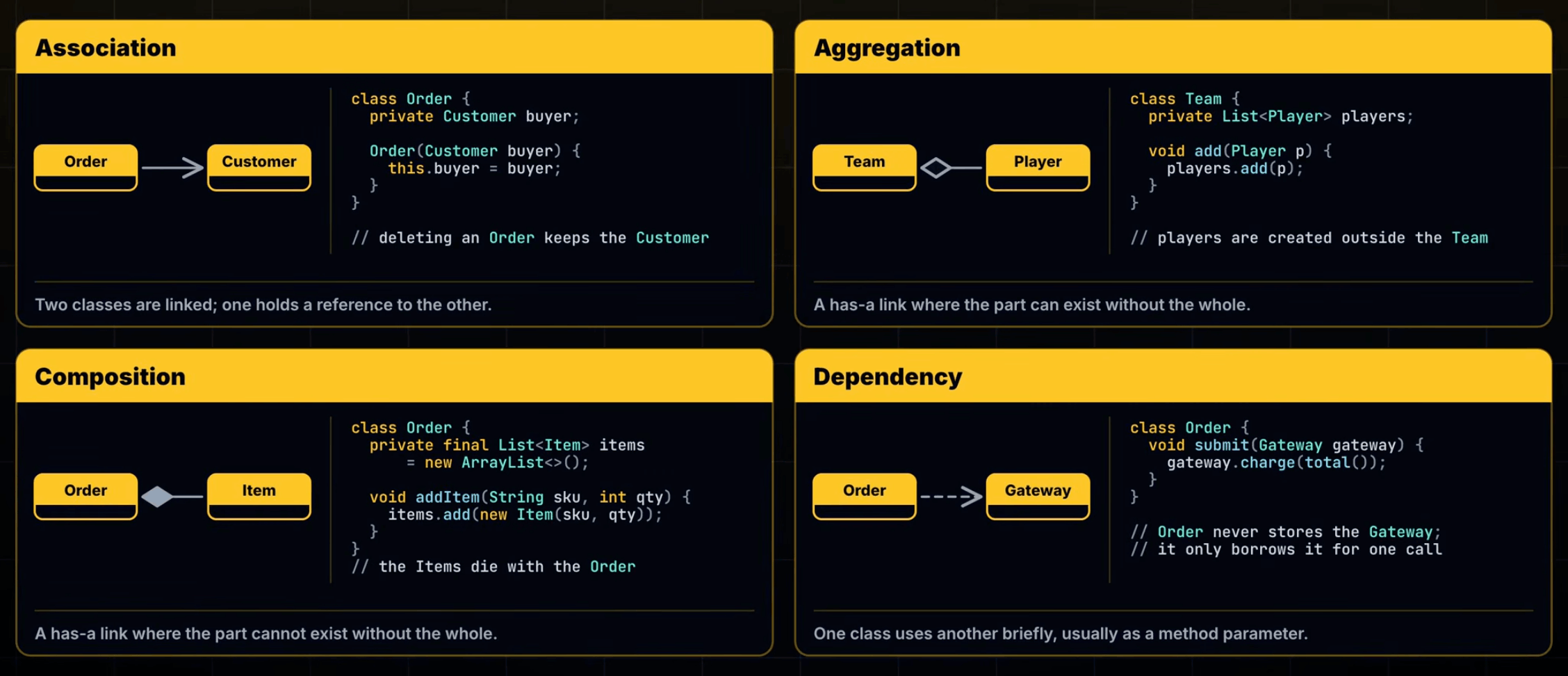
Finally, understand the main class relationships: association, aggregation, composition, and dependency. These relationships help you create clearer class diagrams and define how different objects should interact.
Together, these concepts form the foundation for everything you will learn later in low-level design.
Design Principles
Once you understand the OOP fundamentals, the next step is learning the design principles that help you write clean and maintainable code.
Start with principles such as DRY, KISS, YAGNI, the Law of Demeter, coupling, and cohesion.
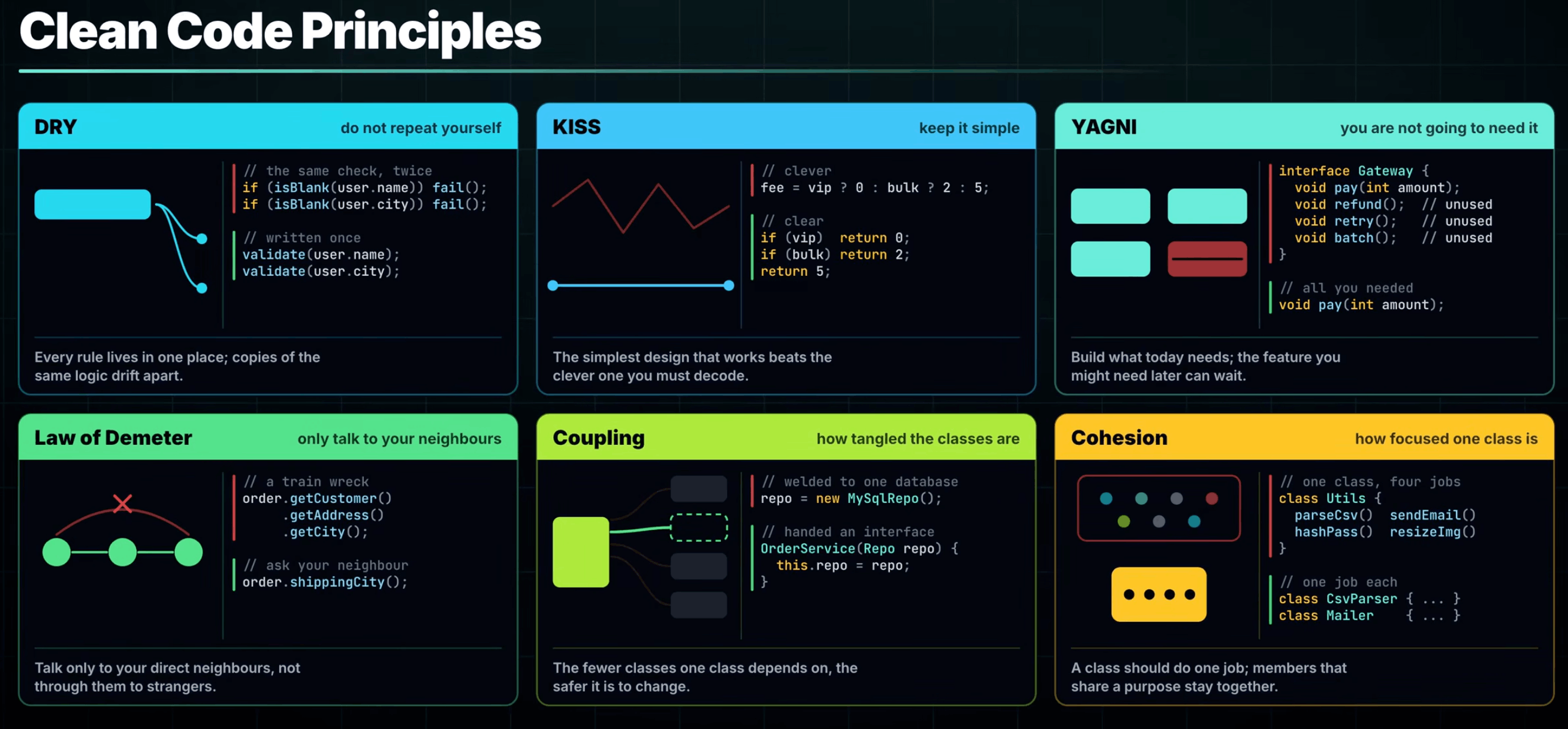
These ideas help you move beyond code that simply works and toward code that is easier to understand, test, modify, and extend.
After that, learn the SOLID principles.
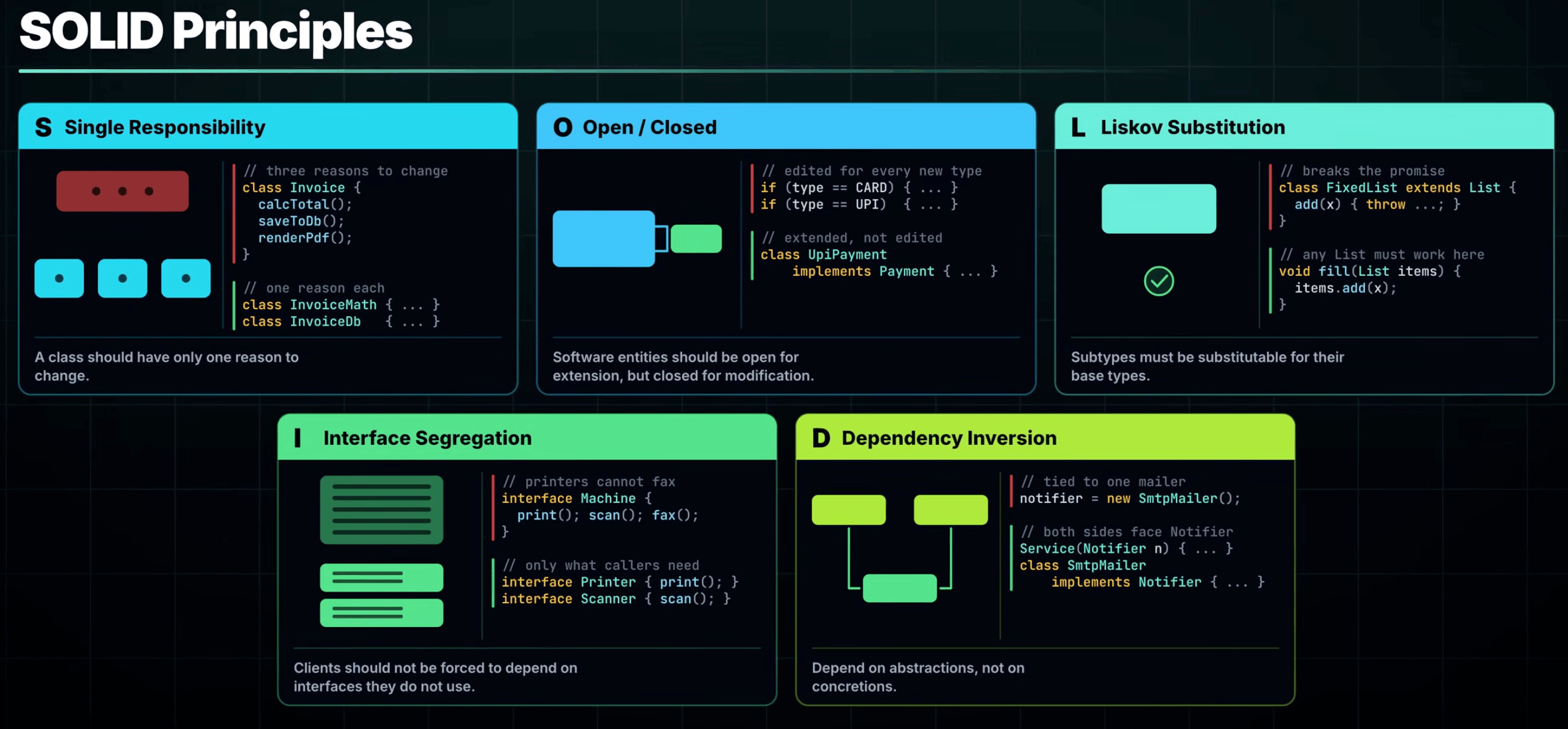
SOLID is especially important in low-level design interviews because it helps you structure your designs and clearly explain the reasoning behind your decisions.
You do not need to memorize every definition. Instead, focus on understanding each principle through practical examples.
This is where OOP, interfaces, and design principles begin to work together.
UML
In most low-level design interviews, you are not expected to draw perfect UML diagrams. Simply outlining the classes, methods, and relationships is often enough.
However, learning a few common UML diagrams can make your designs much easier to understand and explain.
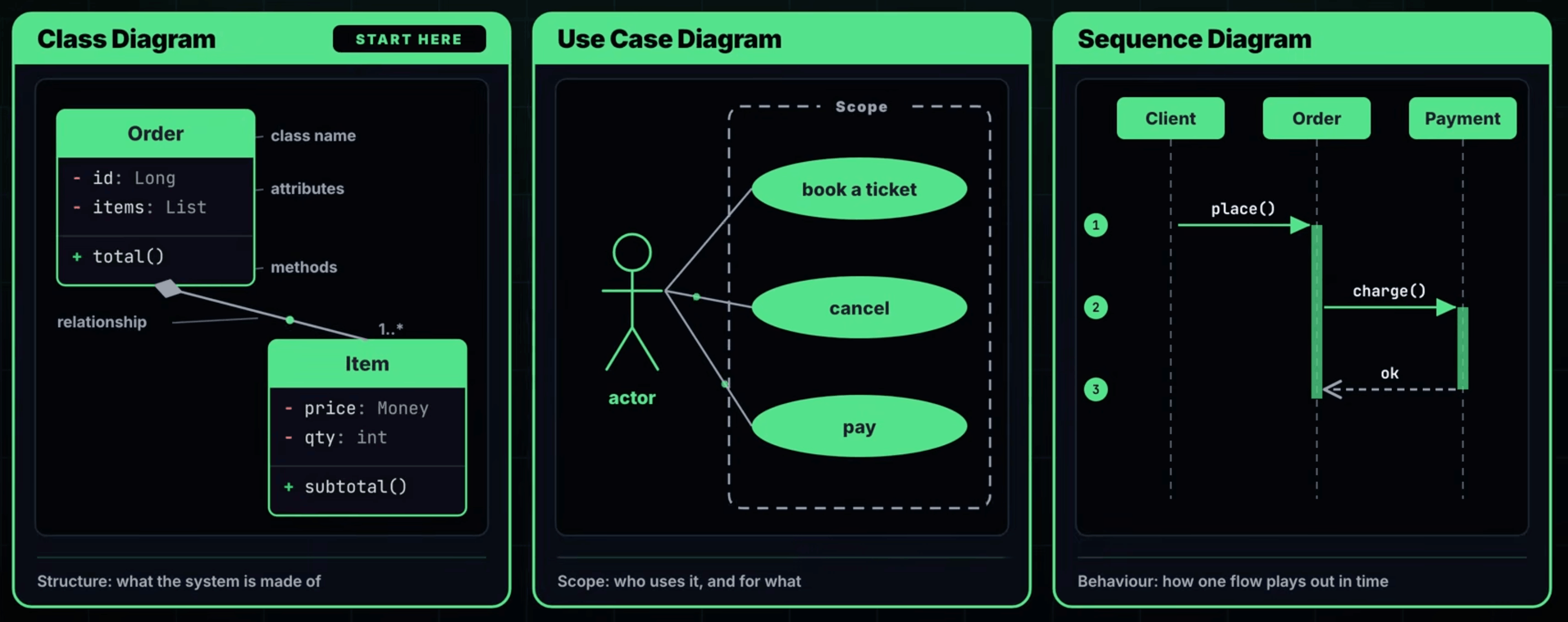
Focus on these three:
Class Diagram
It shows the classes, attributes, methods, and relationships in the system. This is the most important UML diagram for LLD interviews.
Use Case Diagram
This Shows the main users, or actors, and the actions they can perform. It is useful for understanding and clarifying requirements.
Sequence Diagram
This shows how different objects interact step by step during a particular flow, such as placing an order or processing a payment.
You do not need to become a UML expert. Learn just enough to communicate your design clearly and confidently.
Design Patterns
As you gain more experience with object-oriented design, you will notice that many design problems appear again and again.
Design patterns provide proven approaches to solving these recurring problems.
There are 23 classic Gang of Four patterns, but for low-level design interviews, you only need to focus on the ones used most often.
Here are 10 important patterns to learn:
Strategy
Use it when the same task can be performed in different ways, such as processing payments through a card, UPI, or digital wallet.
Observer
Use it when a change in one object needs to notify several others, such as sending updates when an order status changes.
State
Use it when an object’s behavior depends on its current state, such as an order moving from created to paid to delivered.
Facade
Use it to hide a complex subsystem behind a simpler interface.
Factory Method
Use it when the type of object you create depends on the input, such as creating different types of vehicles.
Composite
Use it to represent tree-like structures, such as files and folders.
Decorator
Use it to add new behavior to an object without changing its original class.
Command
Use it when actions need to be represented as objects, such as implementing undo and redo.
Chain of Responsibility
Use it when a request needs to pass through multiple handlers, such as an approval workflow.
Template Method
Use it when several workflows follow the same overall structure but differ in a few individual steps.
The most important thing is not to force a design pattern into every solution. Use one only when it genuinely makes the design cleaner, more flexible, or easier to extend.
How to Prepare for LLD Interviews?
Once you understand OOP concepts, design principles, and common design patterns, the next step is to start solving real interview problems.
LLD problems can feel confusing at first because there is rarely one perfect solution. Different designs may be valid depending on the requirements and trade-offs.
But with practice, you will begin to recognize common patterns. You will get better at turning requirements into classes, defining interfaces, identifying relationships, separating responsibilities, and keeping the design flexible.
Start with these commonly asked problems:
Design a Parking lot
Design a Vending Machine
Design an Elevator System
Design LRU Cache
Design a Chess Game
Design Snake and Ladders
Design Splitwise
Design Logging Framework
Design Hotel Management System
Design a Movie Ticket Booking System
For each problem, do not immediately look at the solution. Try solving it yourself first.
Begin by clarifying the requirements and deciding what is in scope. Then identify the core entities, define their responsibilities, design the class relationships, and finally write the code.
As you work through the design, ask yourself:
Is each class responsible for one clear thing?
Is the design easy to understand and extend?
Am I adding unnecessary complexity?
Could I support a new requirement without rewriting large parts of the system?
After completing your solution, compare it with other approaches and study the trade-offs. The goal is not to memorize one perfect design, but to improve the way you reason about objects, interfaces, and responsibilities.
The more you practice, the better you will become at thinking in terms of objects, interfaces, and responsibilities. And that is exactly what LLD interviews test.
If you want to practice in a realistic interview format, you can use the LLD interview practice feature on AlgoMaster.io. It guides you through each stage of the problem, from clarifying requirements and identifying entities to designing classes and writing working code.
I hope this article gave you a good overview of how to learn low level design.
Thank you for reading!
If you found it valuable, hit a like ❤️ and consider subscribing for more such content every week.
If you have any questions/suggestions, feel free to leave a comment