


Most software systems start simple. A small team, a single codebase, one database, and a few features. At this stage, a monolith is often the fastest and simplest choice.
But as the product grows, that simplicity can become a bottleneck. Teams step on each other’s code, deployments become risky, and one small change can affect the entire system. That is when many teams start looking at microservices.
Microservices can help, but they also introduce distributed systems complexity: network failures, data consistency challenges, observability overhead, and more operational burden.
This is where modular monoliths offer a middle path. They keep the simplicity of a monolith while adding stronger internal boundaries and clearer ownership.
In this article, we will break down monoliths, microservices, and modular monoliths, understand how they differ, when each one makes sense, how to choose the right architecture for your system, and how to migrate between these architectures.
What is a Monolith?
A monolithic application is built and deployed as a single unit.
The UI, business logic, and data access code all live in the same codebase. They are compiled into one artifact, deployed together, and usually run as one process.
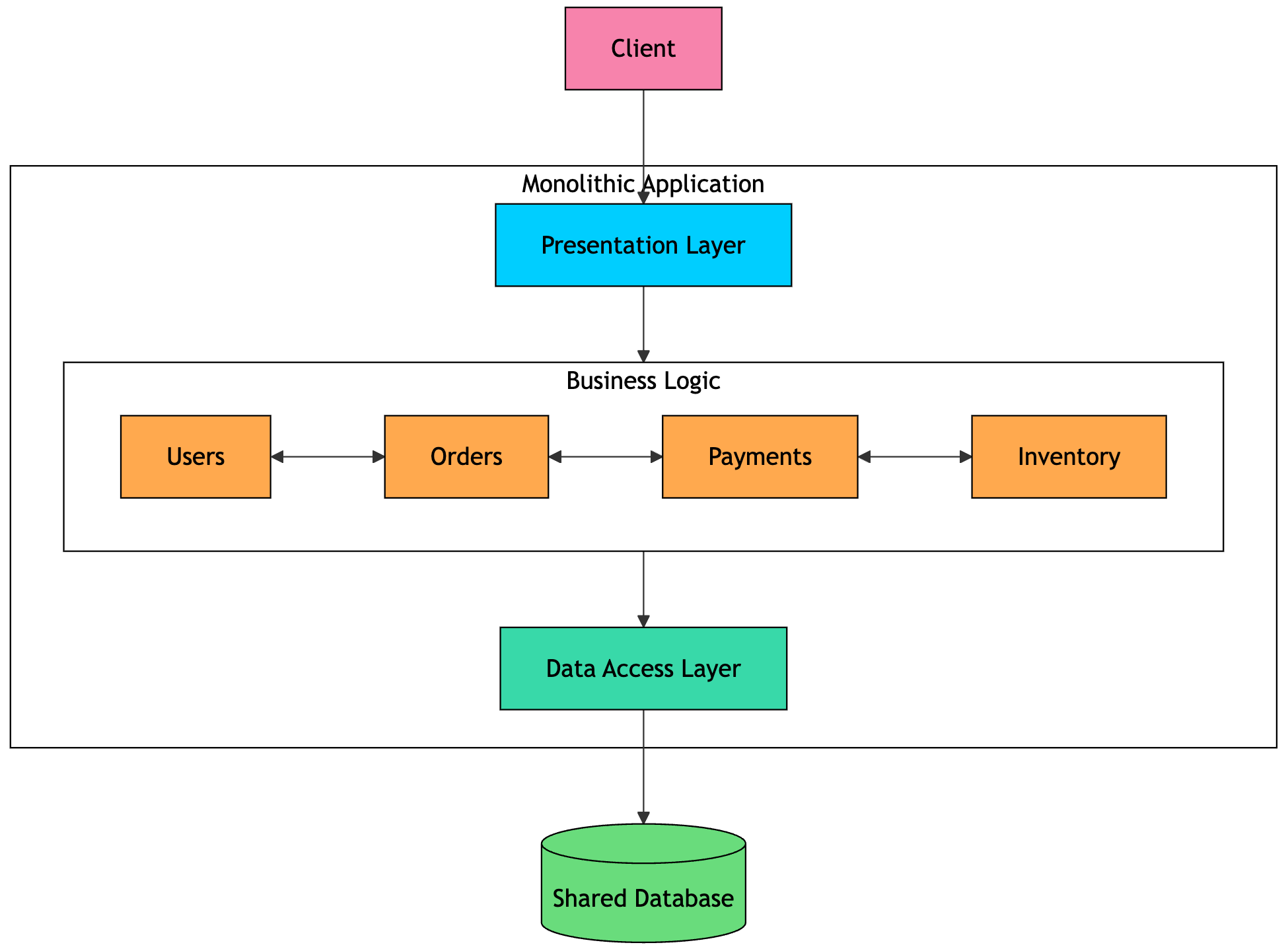
Different parts of the application communicate through direct function calls and often share the same database.
For example, a simple e-commerce monolith might organize code by technical layers:
ecommerce-app/
├── controllers/
├── services/
├── repositories/
└── models/
This structure is easy to understand in the early stages of a product. You clone one repository, run one application, connect one database, and start building.
That simplicity is the biggest strength of a monolith.
There is one codebase to maintain, one deployment pipeline to manage, one process to monitor, and one place to look when something breaks. Database transactions are straightforward, and communication between modules is fast because it happens through normal function calls, not network requests.
But the same simplicity can become painful as the system grows.
A small change in one module may require rebuilding, retesting, and redeploying the entire application. If one module gets heavy traffic, you often have to scale the whole app. One bad query, memory leak, or unhandled exception can affect the entire system. Over time, internal boundaries can blur, and developers may start reaching across modules directly.
Almost every successful application starts as a monolith. The real question is not whether monoliths are bad. The real question is: what should you do when the monolith starts slowing you down?