

Pub-Sub vs Message Queue vs Message Broker
What’s the difference?

When you’re working on a distributed system and need components to communicate asynchronously, you’ll hear terms like: “pub-sub”, “message queue”, and “message broker”.
Although they are used interchangeably sometimes, they’re not the same thing.
Simply put:
A message broker is the infrastructure. Message queues and pub-sub are messaging patterns that brokers implement.
In this article, we’ll explore:
What each term means
How they differ architecturally
When to use each pattern
Real-world examples and use cases
How modern systems like Kafka, RabbitMQ, and Redis fit in
1. The Core Concepts
Before diving into comparisons, let’s define each term clearly.
1.1 Message Broker
A message broker is the middleware infrastructure that receives, stores, and routes messages between producers and consumers. It’s the “thing” that sits in the middle.
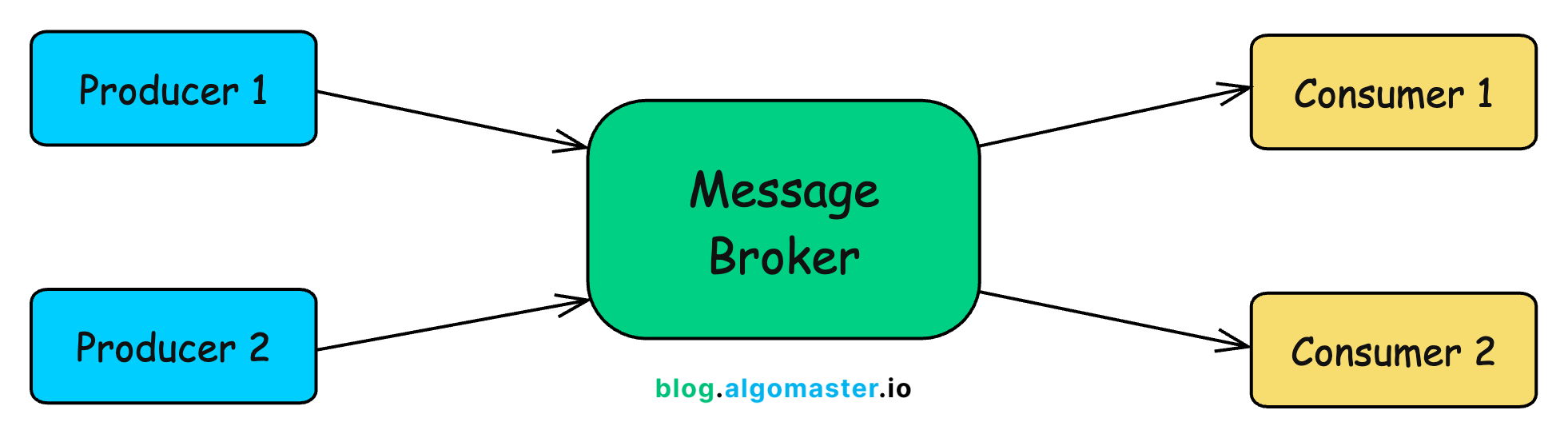
Think of a message broker like a post office. It receives mail (messages), stores it temporarily, and delivers it to the right recipients based on addresses (routing rules).
Examples: RabbitMQ, Apache Kafka, ActiveMQ
Key responsibilities:
Accept messages from producers
Store messages durably or transiently
Route messages to appropriate consumers
Handle delivery guarantees (at-least-once, exactly-once)
Manage consumer acknowledgments
1.2 Message Queue
A message queue is a messaging pattern where messages are sent to a queue and consumed by exactly one consumer. Messages are typically processed in order and removed from the queue after consumption.
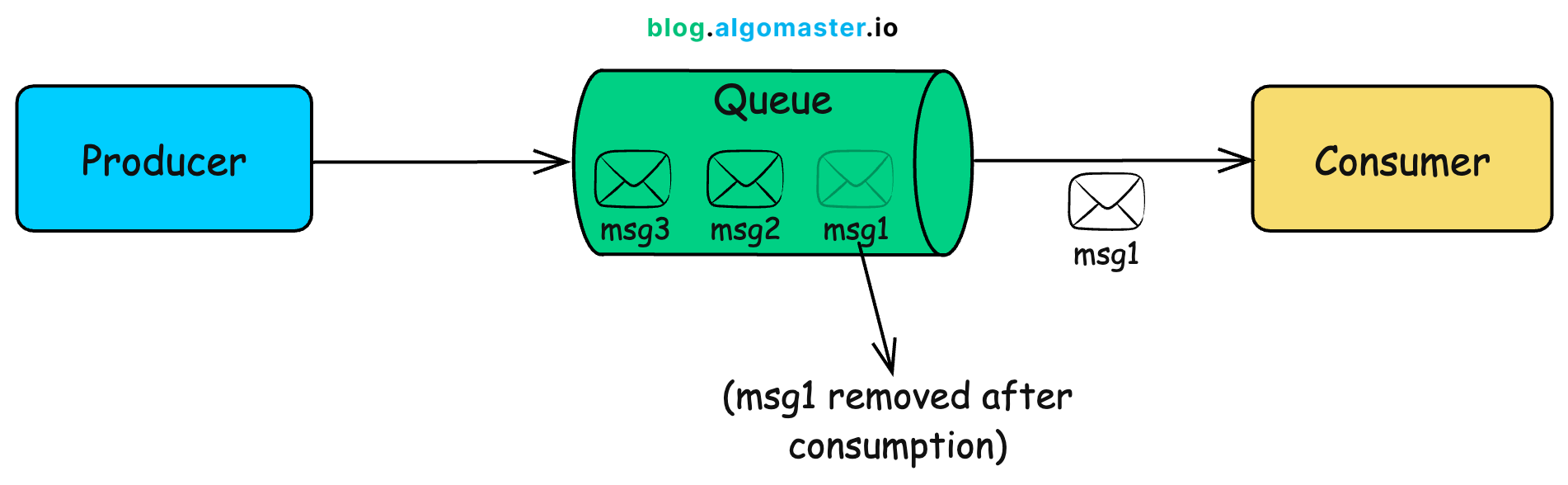
Message queues enable asynchronous service-to-service communication, especially in serverless and microservices architectures. They allow you to build reliable background processing, work distribution, and decoupled systems.
Examples: SQS queues, RabbitMQ queues
When multiple consumers connect to the same queue, they compete for messages. Each message goes to exactly one consumer.
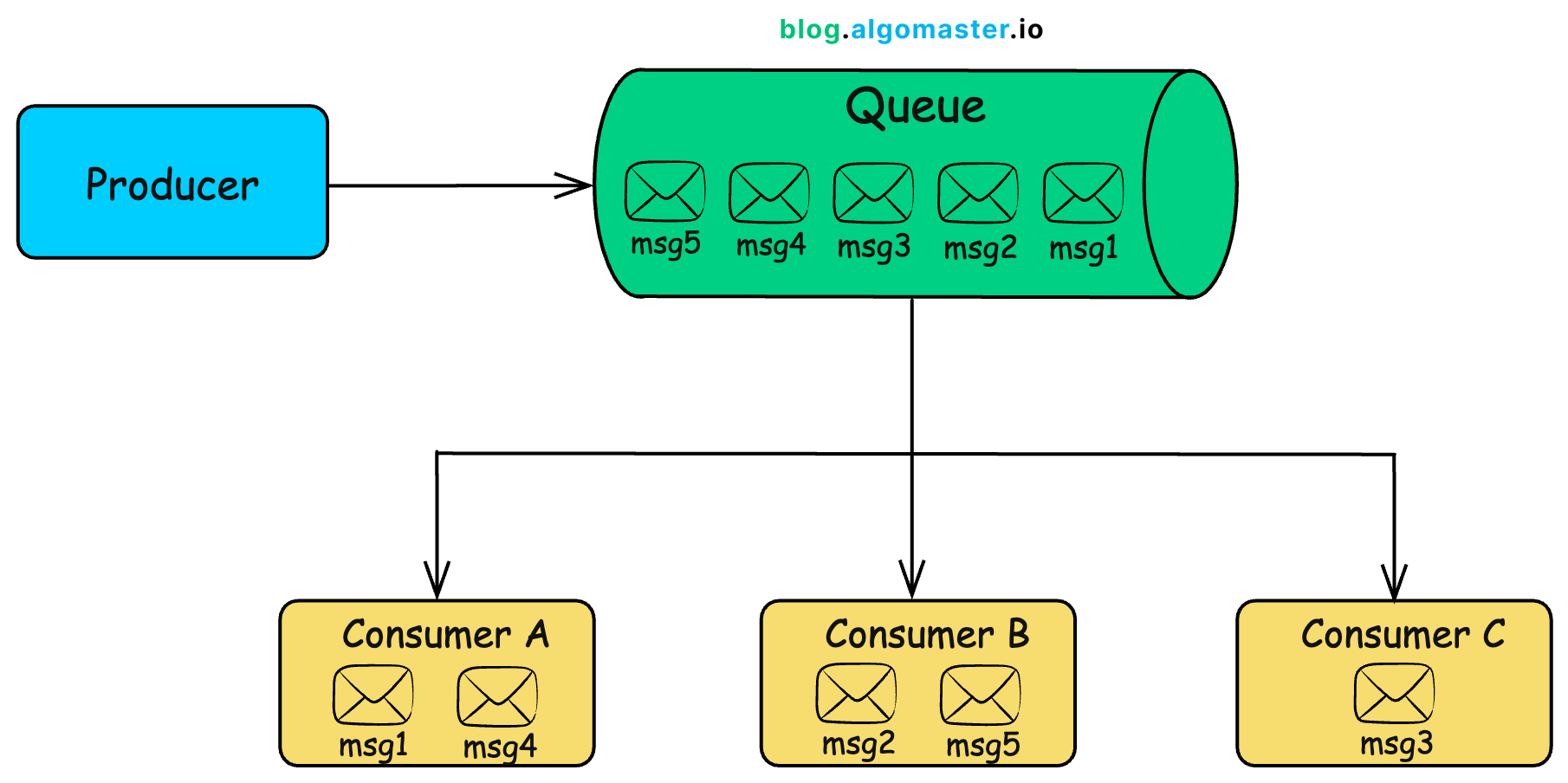
Key Characteristics:
Delivery: Exactly one consumer receives each message
Ordering: First-In-First-Out (FIFO) ordering within a single queue
Persistence: Messages stored until consumed and acknowledged
Acknowledgment: Consumer must confirm successful processing
Retry: Failed messages can be retried or dead-lettered
1.3 Pub-Sub (Publish-Subscribe)
Pub-Sub is a messaging pattern where publishers send messages to topics, and all subscribers to that topic receive a copy of the message. Messages are broadcast, not consumed exclusively.
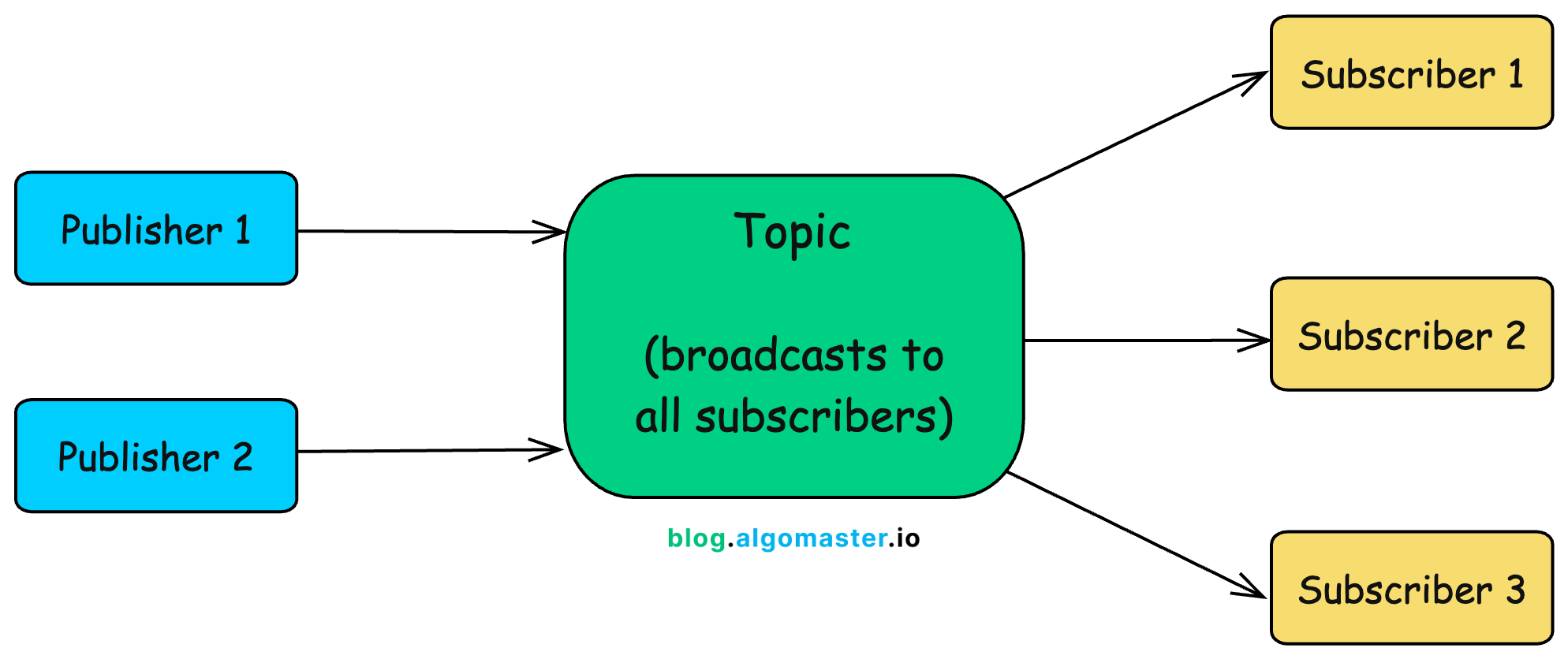
Think of it like a radio broadcast. The station (publisher) broadcasts a signal (message), and everyone tuned to that frequency (subscribers) receives it simultaneously.
It’s an asynchronous communication model that decouples services, making it easier to build scalable, event-driven systems. Pub/Sub is widely used in modern cloud architectures to deliver instant event notifications and enable reliable communication between independent components.
Examples: Redis Pub/Sub, SNS
Pub-sub naturally implements fan-out in event-drive architectures, where one event triggers multiple actions:
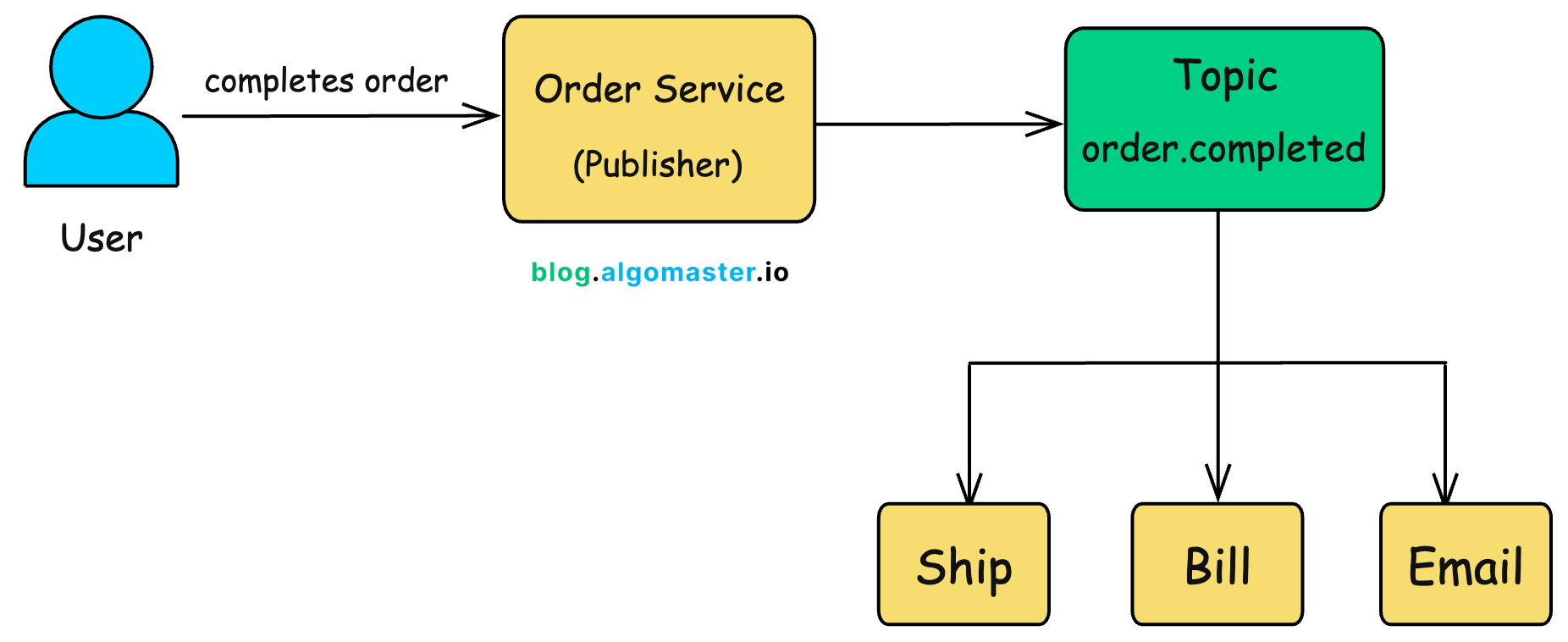
Key Characteristics:
Delivery: One-to-many. Each message delivered to all subscribers.
Decoupling: Publishers and subscribers are decoupled
Scalability: Easy to add new subscribers
Persistence: Messages may or may not be removed after delivery (depends on implementation)
2. How Brokers Implement Both
Modern message brokers typically support both patterns. Here’s how popular brokers handle each:
2.1 RabbitMQ
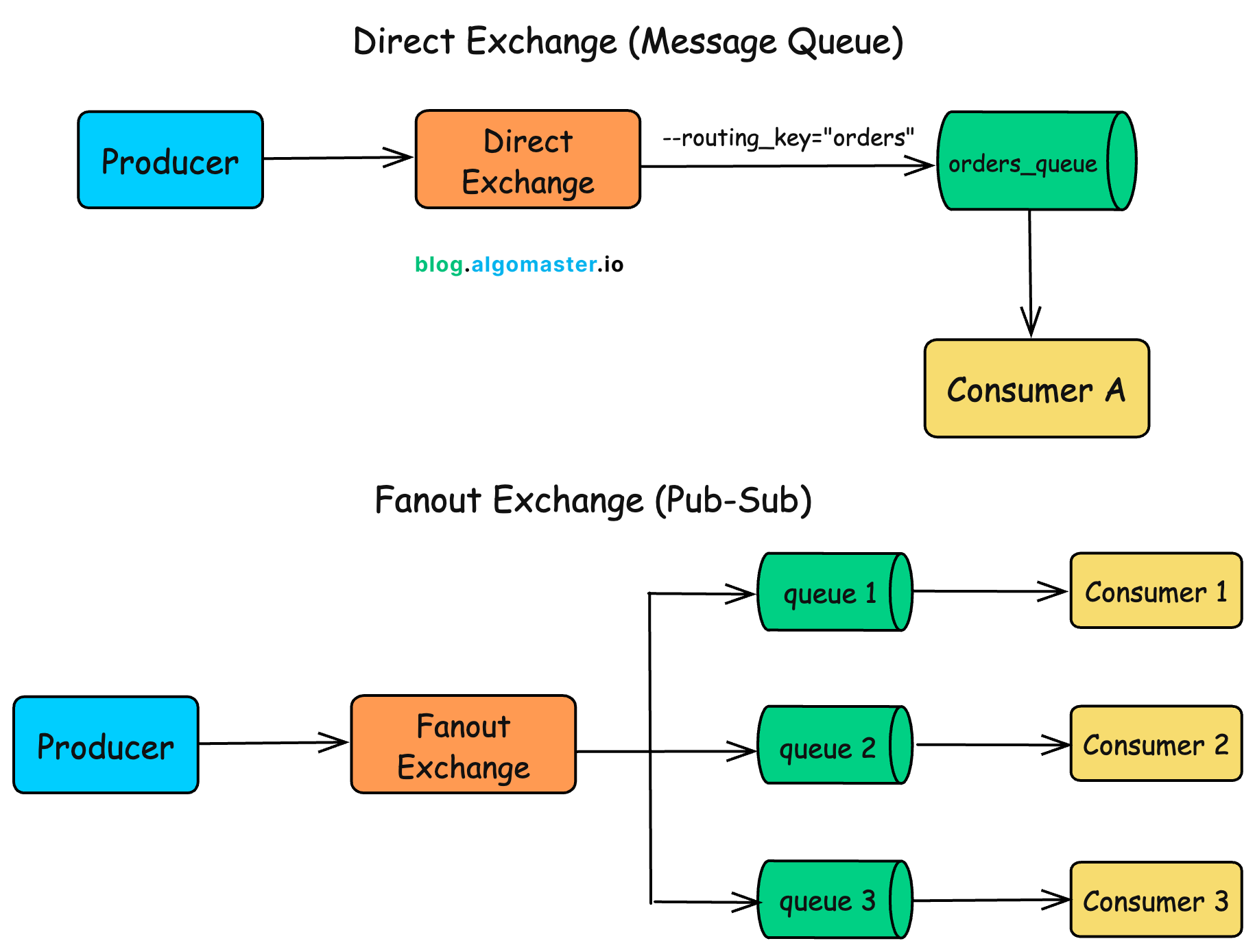
RabbitMQ uses exchanges to support both patterns:
Direct Exchange (Message Queue style): Routes messages to queues based on an exact routing key. Great for work distribution to specific consumers.
Fanout Exchange (Pub-Sub style): Broadcasts every message to all bound queues. Ideal for event broadcasting to multiple consumers.
2.2 Apache Kafka
Kafka’s architecture is built around an append-only log, and it supports both patterns using consumer groups.
Message Queue in Kafka (competing consumers):
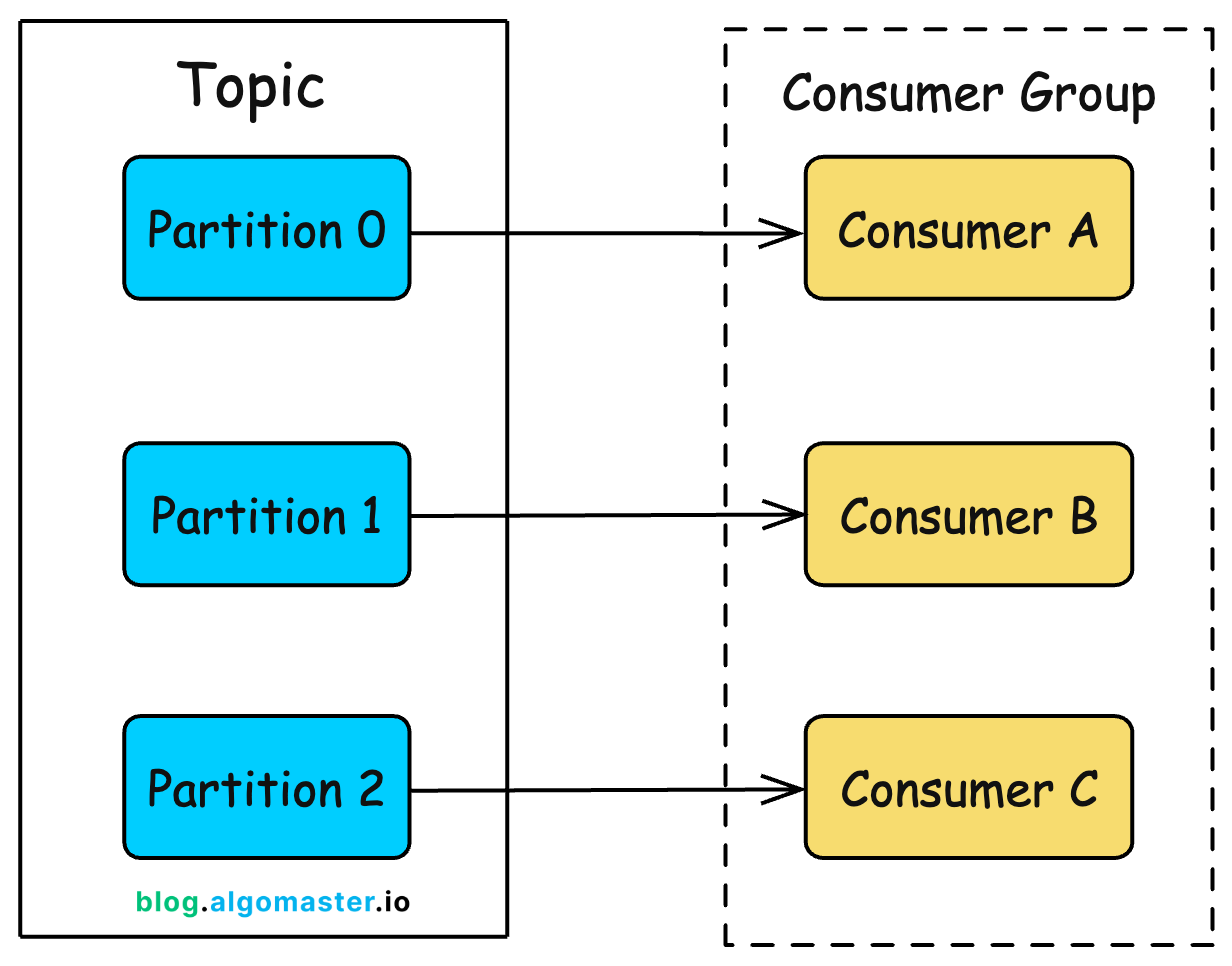
A topic is split into partitions.
In a consumer group, each partition is consumed by exactly one consumer.
Pub-Sub in Kafka (independent consumers):
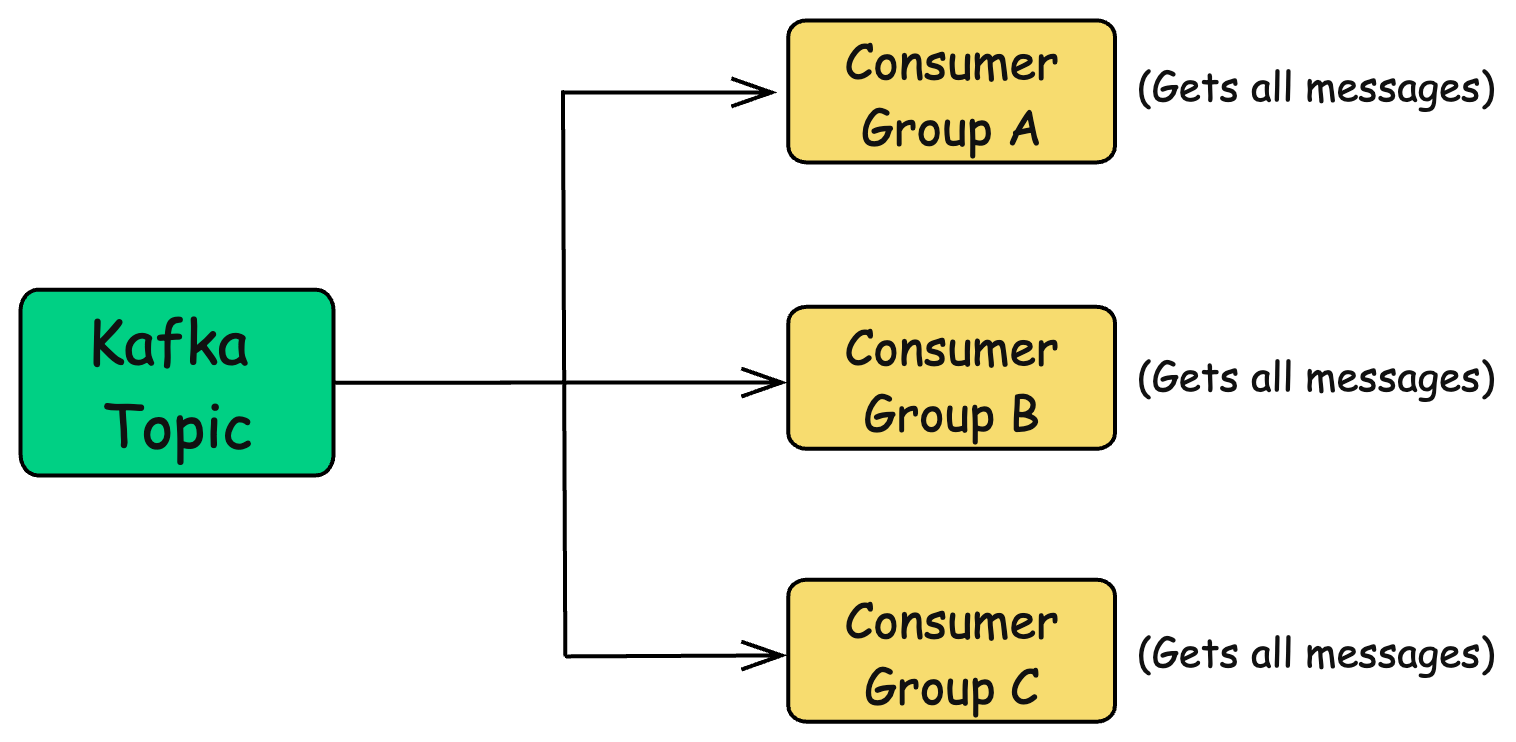
Each consumer group gets all messages from the topic.
You can have many groups (analytics, notifications, billing, etc.), all reading the same stream independently.
Within each group, messages are still load-balanced across consumers like a queue.
2.3 Amazon Services
AWS offers separate services for each pattern.
Simple Queue Service (SQS) for Message Queues
Simple Notification Service (SNS) for Pub-Sub
A common pattern is to combine both SNS and SQS in an even-driver architecture:
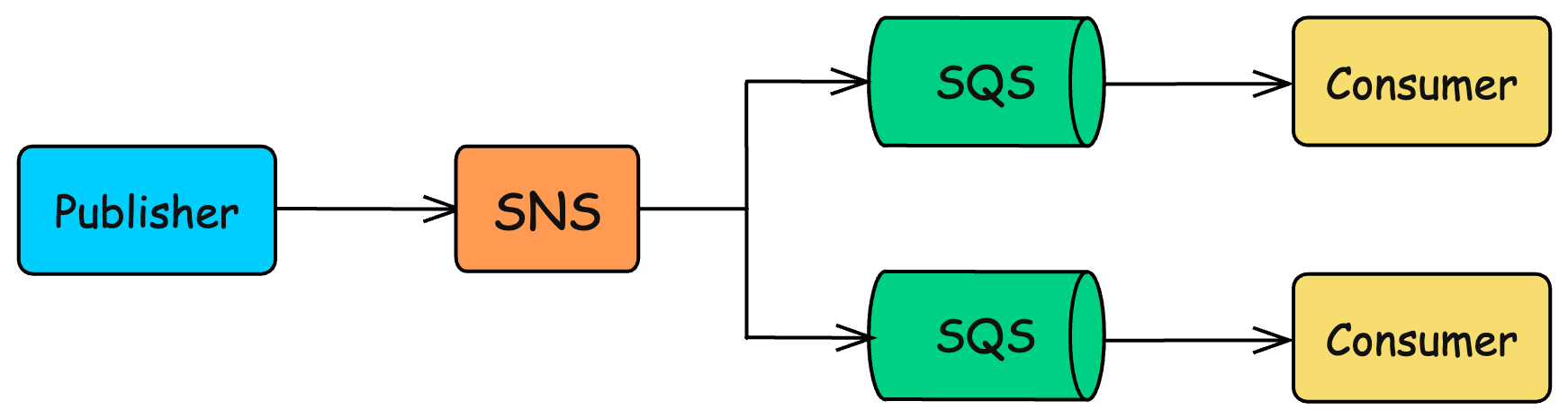
Use SNS for fan-out (publish an event once, deliver to many targets).
Attach SQS queues as subscribers for durable, reliable delivery to each downstream service.
This gives you pub-sub style broadcasting with queue-style reliability and independent scaling for each consumer.
2.4 Redis
Redis supports both patterns using different data structures and commands.
Lists give you queue-like behavior with persistence in memory, while Pub/Sub is ephemeral and only delivers messages to clients that are currently subscribed.
Lists (Message Queue):
Use a list as a simple queue: producers push, consumers block and pop.
LPUSH myqueue “message” --> Publisher sends a message

BRPOP myqueue 0         --> Consumer blocks until a message is available
Pub/Sub (Broadcast):
Use Redis Pub/Sub to broadcast messages to all active subscribers.
PUBLISH channel “message”  --> Publisher sends a message

SUBSCRIBE channel          --> Subscriber listens for messages
3. Choosing the Right Pattern
A message queue is about work. Each message represents a unit of work that should be done once by one worker.
Pub-Sub is about events. Something happened, and many services might care.
Use a Message Queue when you need:
Task processing: Each task must be executed exactly once.
Work distribution: You want to spread load evenly across multiple workers.
Background jobs: Long-running or async tasks with reliable delivery.
Rate limiting: You need to control how fast consumers process messages.
Sequential processing: FIFO ordering for messages in a queue.
Use Pub-Sub when you need:
Event notifications: Multiple services should react to the same event.
Real-time updates: Broadcast changes (e.g., price updates, notifications) to many clients.
Decoupled microservices: Publishers and subscribers can evolve independently without tight coupling.
In short:
If every message is “do this work once,” you’re in message queue territory.
If every message is “this happened, whoever cares may react,” you’re in pub-sub territory.
Summary
Message queues and pub-sub are patterns, not mutually exclusive tools. A message broker is the infrastructure that often supports both.
Need one consumer per message? → Use a Message Queue.
Need every subscriber to get every message? → Use Pub-Sub.
Most real-world systems combine them:
Pub-Sub for cross-service events.
Queues for work distribution within or behind services.
Modern brokers (Kafka, RabbitMQ, cloud messaging services) usually support both patterns. The key is to choose based on delivery semantics and durability requirements, not on tool names alone.
Thank you for reading!
If you found it valuable, hit a like ❤️ and consider subscribing for more such content.
P.S. If you’re enjoying this newsletter and want to get even more value, consider becoming a paid subscriber.
As a paid subscriber, you’ll unlock all premium articles and gain full access to all premium courses on algomaster.io.
There are group discounts, gift options, and referral bonuses available.
Checkout my Youtube channel for more in-depth content.
Follow me on LinkedIn, X and Medium to stay updated.
Checkout my GitHub repositories for free interview preparation resources.
I hope you have a lovely day!
See you soon,
Ashish